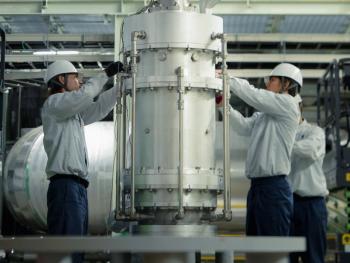

2025 orders hit a four-year high as gas turbine backlogs push data center developers toward a faster fix, but the rebound is landing just as one of the industry's largest OEMs explores selling the business behind it.
Figure shows the comparison between the original and current airfoil designs. The old airfoils form a channel in which steam flow accelerates and turns to exit with maximum steam velocity resulting in high secondary losses.
Current airfoils form a channel in which steam flow turns first with low steam velocity and then accelerates. Low steam velocity forms a thin boundary layer resulting in low secondary losses. The current airfoil design has two other advantageous features; it is much stronger than the original design and it has improved inlet edge geometry. The latter allows for steam flow at a wider range of angles without significant separation. Using the new airfoil design yields an increase in stage efficiency of 0.5-1.0%.
(Tutorial on steam turbine airfoils will continue in subsequent weeks)