
News|Articles|June 2, 2026
Baker Hughes CEO: Turbines, LNG, and AI Data Centers Define the Next Decade of Industrial Energy
Author(s)Alicia Bigica
Listen
0:00 / 0:00
Key Takeaways
- Strategic repositioning since 2022 deemphasized oilfield services cyclicality, centering portfolio growth on industrialized energy solutions linking energy supply to end-use outcomes.
- A >9,000-unit rotating-equipment installed base with 20–30-year lifetimes drives “razor–razorblade” aftermarket economics, including >90% LNG service attachment and 45–50% fleetwide.
Baker Hughes Chairman and CEO Lorenzo Simonelli outlined a decade-long growth cycle for industrial energy centered on turbomachinery, LNG, and AI data center power, highlighting the company’s shift toward industrial energy technology.
Advertisement
Baker Hughes Chairman and CEO Lorenzo Simonelli used the Bernstein 42nd Annual Strategic Decisions Conference on May 27, 2026, to deliver a clear message to turbomachinery professionals: the next decade of energy infrastructure will be built around rotating equipment, compression, and gas turbines.
From
Simonelli stressed that Baker Hughes has moved beyond the traditional oilfield services model. Since launching its strategic transformation in 2022, the company has reorganized around industrialized energy solutions that connect energy sources to industrial outcomes.
Turbines, compressors, pumps, and valves now sit at the core of a diversified portfolio serving:
- LNG liquefaction and export
- Pipeline and midstream infrastructure
- Power generation and grid support
- Off-grid power for AI and high-performance computing data centers
- Carbon capture, utilization, and storage (CCUS)
- Geothermal and hydrogen projects
By the end of 2025, Baker Hughes had expanded EBITDA margins by more than 300 basis points and nearly doubled EBITDA. The IET segment now represents roughly half of total company business, and Simonelli signaled that its share will continue to increase as industrial energy demand grows.
Turbomachinery Differentiation: Installed Base and Aftermarket
Simonelli contrasted Baker Hughes’ portfolio with upstream-focused peers such as SLB and Halliburton. The company has built one of the world’s largest installed bases of rotating equipment, with more than 9,000 units in operation and typical lifespans of 20 to 30 years.
This installed base underpins a high-margin aftermarket:
- >90% attachment rates on LNG service agreements
- 45–50% attachment rates across the broader fleet
Simonelli described the business model as a classic “razor–razorblade” structure, where long-lived equipment drives recurring service and parts revenue. Looking ahead, Baker Hughes has committed to more than $40 billion in IET order intake between 2026 and 2028, signaling continued growth in turbomachinery deployments.
Strait of Hormuz Constraints: A Catalyst for Infrastructure Build-Out
Geopolitics featured prominently in Simonelli’s outlook, which he shared with Bernstein’s Bob Brackett, co-head of Energy and Transition and Global Metals and Mining. He warned that ongoing constraints in the Strait of Hormuz are a drag on the global economy by limiting the flow of crude oil and other hydrocarbons. However, he also argued that the response will likely be a multi-year wave of infrastructure investment.
Expected developments include:
- New pipeline corridors in the Middle East designed to bypass the Strait
- Additional LNG export facilities to diversify supply routes and locations
- Broader upstream and midstream diversification to reduce chokepoint risk
For turbomachinery suppliers, these projects translate into sustained demand for compressors, pumps, and gas turbines across pipelines, processing plants, and export terminals.
LNG Turbine Supply and Global Capacity Expansion
Simonelli addressed the current tightness in LNG turbine supply, particularly in light of reported physical damage at Qatari facilities. Replacement timelines for large-scale LNG turbomachinery have extended to three to five years, driven by supply chain constraints rather than project cancellations.
Key points from his LNG outlook:
- Qatar’s Northfield West and Northfield East expansions remain on track.
- LNG diversification is accelerating, with active or advancing projects in Argentina, Algeria, the U.S. Gulf Coast, and Mozambique.
- Baker Hughes continues to forecast 800 million tons per annum (MTPA) of required global LNG capacity by 2030, rising to 950 MTPA by 2035.
For turbomachinery professionals, this implies a long runway of demand for liquefaction trains, refrigeration compressors, and associated rotating equipment as LNG infrastructure expands beyond traditional hubs.
Gas Turbines for AI Data Center Power
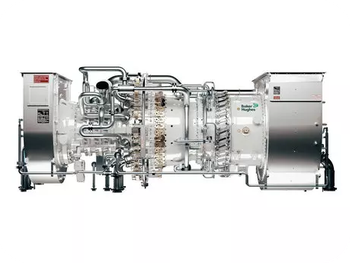
One of the most notable growth vectors Simonelli highlighted is off-grid power for AI data centers. Baker Hughes is targeting this segment with its NovaLT 16 and Frame 5 gas turbines, integrated with BRUSH generators, to deliver modular power blocks in the 150–300 MW range.
According to Simonelli:
- The company sees continuous demand for 150–300 MW off-grid solutions.
- In Q1 2026 alone, Baker Hughes booked $1 billion in data center orders in its Power Systems line, matching the total for all of 2025.
- The initial $3 billion revenue target for 2025–2027 from data centers has already been revised upward.
Importantly, these turbine packages were designed for multiple end markets, including pipelines and industrial sites, with data centers emerging as a particularly strong demand driver.
New Energy Applications: Compression at the Core
Baker Hughes’ New Energy segment, which includes CCUS, geothermal, hydrogen, and emissions abatement, has scaled rapidly:
- Revenue grew from a few hundred million dollars in 2022 to over $2 billion in 2025.
- The company projects $2.4–$2.6 billion in 2026 revenue.
- The stated 2030 target is $6–$7 billion.
Across these applications, compression and rotating equipment remain the common denominator:
- CCUS: CO₂ must be compressed for transport and injection into geological storage formations, supported by drilling and monitoring technologies.
- Hydrogen: Requires specialized compression for pipeline transport, storage, and end-use delivery.
- Geothermal: Leverages subsurface expertise and steam turbine technology for power generation.
- Emissions abatement: Projects like Baker Hughes’ large-scale de-flaring initiative in Iraq depend on capturing and recompressing associated gas.
Simonelli emphasized that Baker Hughes already possesses the core capabilities required for these systems: drilling, compression, monitoring, and turbomachinery integration.
Long-Term Outlook: An Energy Demand Decade
Simonelli characterized the coming years as an “energy demand decade,” driven by rising global energy consumption; increased infrastructure investment across oil, gas, and power; growth in CCUS and low-carbon projects; and expansion of AI and digital infrastructure requiring reliable, high-density power.
He argued that these trends collectively support a strong trajectory for Baker Hughes and the broader turbomachinery sector. Rotating equipment, pumps, valves, and turbines will be central to:
- New pipelines and midstream systems
- Additional LNG trains and export terminals
- Gas-fired and hybrid power generation assets
- CCUS, hydrogen, and geothermal projects
The
Simonelli’s position was clear: compression and rotating equipment are not legacy tools of a maturing oil and gas sector, but foundational infrastructure for the next 30 years of the global energy system.
Advertisement
Related Content
Advertisement
Advertisement
Advertisement