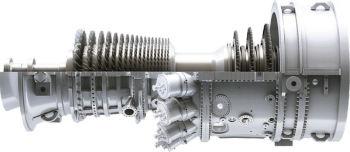

The Denver startup plans factory-built supercritical carbon dioxide systems designed to recover gas turbine exhaust heat.
There is always some degree of thrust bearing misalignment due to housing and bearing machining tolerances, or misalignment between the shaft and housing. This is considered static misalignment since the bearing is misaligned before a load is applied. This static misalignment is different from dynamic misalignment that may occur when thermal expansion and mechanical deflection causes shifts in the housing and shaft position while in operation.
For this example, the equalizing bearing has a spherical thrust shoe support and is a leveling plate or rocker type design. The static misalignment condition is based on the assumptions that the collar (or thrust disc) is perpendicular to the shaft, the collar surface is flat and smooth, and the runout is within an acceptable tolerance.
An equalizing thrust bearing distributes the load more evenly among the pads compared to a non-equalizing bearing. When a load is applied, the thrust pad pushes against the upper leveling plate. This forces the lower leveling plates on either side to tilt slightly and raise the pads on the other side. This reaction occurs on every pad and equalizes the thrust load.
Capacity is greatly improved over non-equalizing bearings although the system is not perfect. There are physical limitations such as loss of leverage due to shifts in pivot contacts. This results in a pad load differential that increases with misalignment and depends on the bearing geometry, contact radii, and the number of shoes.
For the balance of the article and associated illustrations,
Contributed by: David M. Casper, Engineering Service Coordinator, Kingsbury, Inc.